Up


World Innovation Ranking
2026
7 months ago
Subscribe
Decoding the «Future»: World Innovation Ranking 2026
In a rapidly shifting global economy, traditional financial metrics often fail to capture the true potential of radical innovations. The World Innovation Ranking 2026 was created to bridge this gap, offering a standardized lens through which we measure progress, market uniqueness, and financial viability. Our unique methodology isn't just a list - it's a rigorous research framework designed
Show more
157 days left to participate$6,590 / $30,000
Minimum$5
Maximum$2,000
Deadline30/12/2026
39 Sponsors
89
5
3

Artem Vershinsky
ARCH
10 days ago
Subscribe
Why this fire truck's rear wheels turn on their own: inside the tiller ladder
Watch the rear axle closely and you'll notice it pivots independently from the front wheels - this is a tiller ladder truck, a fire apparatus built in two connected sections like a giant articulated vehicle. A dedicated driver, called the tillerman, sits in a rear cab and steers the back axle by hand, letting a truck stretching 55–60 feet navigate turns that would be impossible for a single rigid
Show more
61
1
0
World Innovation Ranking
2026
a month ago
Subscribe
Open Banking 2026: 30 innovative neobanks ranked by Arch Town Labs
Thirty companies. Six regions. Four innovation stages. The Open Banking nomination in the Arch Town Labs World Innovation Ranking 2026 is one of the most globally distributed cohorts in the entire ranking - and one of the most structurally revealing. The scores tell a sector story, not a company story. The aggregate picture of 30 assessed neobanks, embedded finance platforms, and digital bank
Show more
55
5
0
World Innovation Ranking
2026
21 days ago
Subscribe
Record VC, record layoffs - which story is real?
It's a boom
It's a bust
Both, for different companies
Neither, it's noise
11 votes
48
4
0
Artem Vershinsky
ARCH
21 days ago
Subscribe
How a jet engine actually pushes a plane forward - in 15 seconds
This simple 3D animation breaks down exactly how a turbojet engine works. The fan pulls air into the engine, the compressor accelerates it, and the exhaust pushes it out the back - generating the thrust that lifts an aircraft into the sky. It's Newton's third law in action: every push backward creates an equal push forward. The clip has already racked up tens of thousands of views for making a co
Show more
47
3
0
Artem Vershinsky
ARCH
19 days ago
Subscribe
Watch: rocket landing caught on raw monitor footage
This clip shows a rocket landing, filmed directly off a live monitor feed - timestamp still visible in the corner. The booster fires its engines to slow its descent and touches down under its own power between the launch support structure, a maneuver that only a handful of programs worldwide have mastered. The unpolished, screen-recorded quality gives it a behind-the-scenes feel rarely seen in of
Show more
43
0
0
Artem Vershinsky
ARCH
14 days ago
Subscribe
A giant robot sculpture has "landed" on Shenzhen Bay's waterfront
A massive android sculpture, half-emerged from the pavement with a chrome body, glowing blue circuitry, and a human face, has appeared along Shenzhen Bay's waterfront as part of the city's tech festival programming. The installation has quickly become a new photo landmark, framed against the district's glass skyline. It's the latest in a string of striking public art pieces that lean into Shenzhe
Show more
43
4
0
Artem Vershinsky
ARCH
7 days ago
Subscribe
Earth's magnetic field vs. the solar wind: how the magnetosphere protects the planet
The Sun continuously ejects around 1.5 million tons of charged particles into space every second, traveling at hundreds of miles per second as the solar wind. This 3D animation shows how Earth's magnetic field deflects that stream, wrapping it around the planet in a teardrop-shaped protective bubble known as the magnetosphere. Without it, the solar wind would strip away the atmosphere over time,
Show more
39
5
0
World Innovation Ranking
2026
14 days ago
Subscribe
Sovereign AI: real strategy or political theater?
Real, governments need control
Mostly optics
Real for defense only
Too soon to say
Vote
37
3
0
Artem Vershinsky
ARCH
15 days ago
Subscribe
A medieval peasant would call this witchcraft. It's just a forestry harvester.
This clip shows a forestry harvester head in action: it grips a standing tree, cuts it at the base, strips off every branch in one continuous motion, and leaves a clean log ready for processing - all in a matter of seconds. Work that once took a team of loggers with axes and saws half a day is now handled by a single operator from inside a cab. It's a striking snapshot of how far mechanized loggi
Show more
35
3
0
World Innovation Ranking
2026
9 days ago
Subscribe
The trucks are smarter than the cities: what iRank's smart city and logistics board shows

Arch Town Labs screened its iRank database for the Smart City and Logistics nomination across all startup stages: building, growing, scaling and unicorning. The result is a lopsided board. The logistics side of the category is producing real, fundable innovation. The smart city side, at least among startups, currently has nothing to show. Before getting to the board itself, it is worth
Show more
34
3
0
World Innovation Ranking
2026
25 days ago
Subscribe
Moscow 2026: The Architecture of a Closed-Loop Superpower
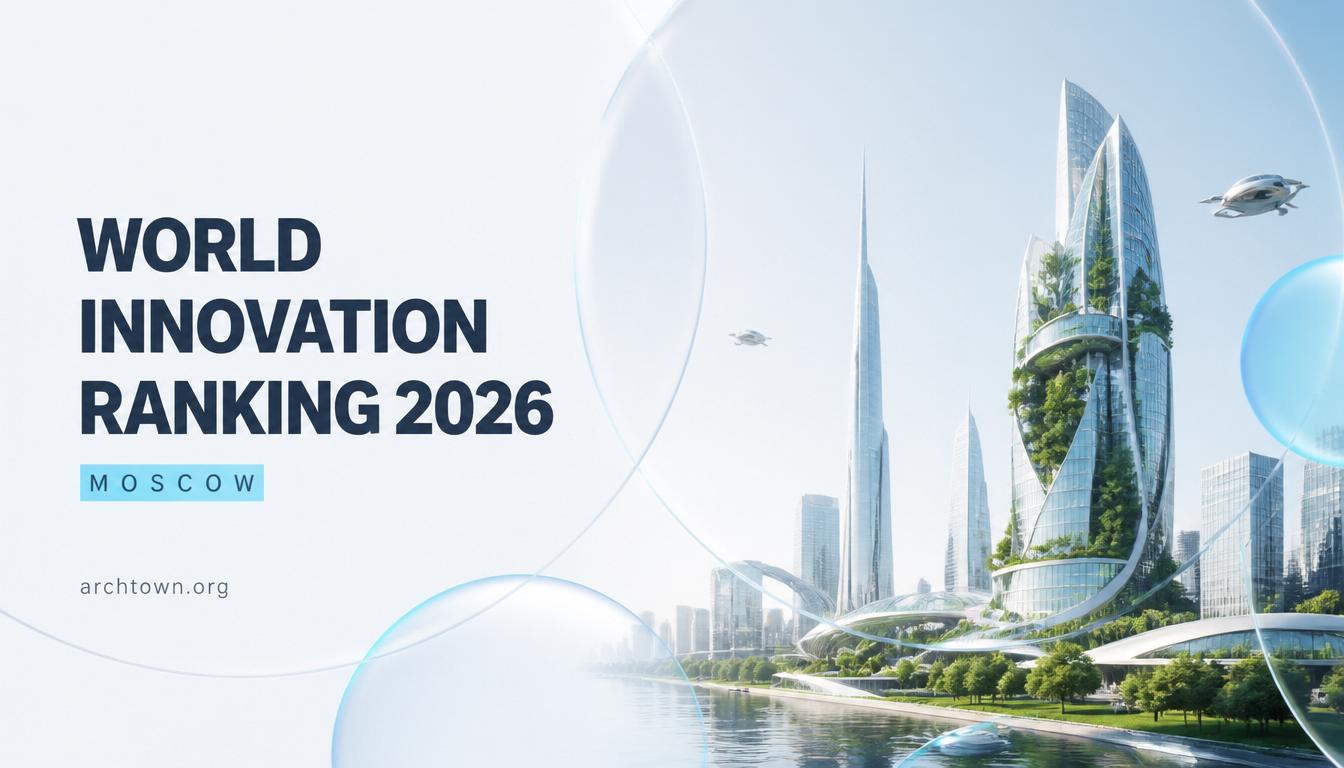
1. Executive overview: Moscow in 2026 Moscow is a paradox in the global innovation economy. It is home to one of the largest domestic tech markets on the planet, a search and AI company (Yandex) that competes on model quality with the leading US and Chinese labs, and a state-backed bank (Sber) running one of the most aggressive enterprise AI rollouts anywhere. At the same time, it is cut off fro
Show more
33
3
0
World Innovation Ranking
2026
4 days ago
Subscribe
Almaty 2026: Where the Super-App Ate the Bank

1. Executive overview: Almaty in 2026 Almaty is Kazakhstan's commercial capital and the operational center of gravity for the country's private technology sector, even though the government moved the political capital to Astana decades ago and has since concentrated its flagship tech-policy showcase there. What Astana Hub represents in incentive architecture, Almaty represents in actual company
Show more
31
3
0
Artem Vershinsky
ARCH
16 hours ago
Subscribe
FPV drone footage of LandSpace's Zhuque-2 Y6 rocket launch is stunning
An FPV racing drone chases LandSpace's Zhuque-2 Y6 rocket from the moment it clears the launch tower, staying locked onto the vehicle as it accelerates skyward and sheds insulation panels along its climb. Zhuque-2 is best known as the world's first methane-fueled rocket to reach orbit, and this launch is being called the company's cleanest flight to date.
27
1
0
Artem Vershinsky
ARCH
9 days ago
Subscribe
Plasma vortex in a magnetic field: a DIY electric arc experiment explained
In this experiment, an electric arc is struck between two electrodes positioned inside a ring magnet, and the magnetic field bends the ionized plasma into a rotating, glowing vortex instead of letting it arc in a straight line. It's a small-scale demonstration of magnetohydrodynamics, the same branch of physics that governs how magnetic fields confine and shape plasma in fusion reactors and stars
Show more
25
1
0
Artem Vershinsky
ARCH
3 days ago
Subscribe
Laser skin resurfacing up close: the non-injectable alternative to Botox
This extreme close-up shows a fractional laser resurfacing treatment in action, where tiny, precisely controlled micro-burns are applied across the skin's surface. Rather than freezing muscles like Botox, the laser works by triggering the skin's natural healing response: as the micro-injuries repair, they stimulate new collagen production, gradually smoothing texture, fine lines, and uneven tone.
Show more
24
2
0