WORLD INNOVATION RANKING 2026: Skyscrapers City-States Roundup by Arch Town Labs
Visiting Card: The State of Doha in the Global Economy of 2026
By February 2026, the global economic landscape has been redrawn, not by broad strokes of globalization, but by precise, localized hubs of high-value innovation. In this new landscape, Doha has emerged as a financial and intellectual hub, rather than just a wealthy hydrocarbon exporter. It operates on a unique logic that differs from its regional neighbors, and has become a "sovereign intelligence" center. While the world was skeptical of the post-World Cup era, anticipating a recession, Doha executed a methodical turnaround. The city of Doha in 2026 is a case study in calculated ambition. It leverages its immense capital surplus to buy the one asset that can't be extracted from the ground - a future-proof knowledge economy.
The macroeconomic context of 2026 is defined by a unique dual-engine growth model. On the one hand, the hydrocarbon engine is firing at historic levels. North Field expansion projects have come online, boosting LNG production toward the target of 126 million tonnes per year. This massive injection of liquidity - projected to drive real GDP growth to 5.3% in 2026 and peak at 6.8% in 2027 - provides the state with a fiscal buffer that is envied by the developed world. However, unlike previous boom cycles, where revenues were poured into concrete and glass, the surplus of 2019 is being channeled into silicon and code. The Third National Development Strategy (2024-2030) shifted the nation's KPIs from infrastructure completion to productivity growth, targeting a 4% annual growth rate for the non-oil sector.
This shift is visibly manifested in the city's atmosphere. In early 2026, Doha will host the third edition of the Web Summit Qatar, an event that has gone beyond its initial novelty and become a crucial node in the global tech calendar. With more than 30,000 attendees at the Doha Exhibition and Convention Center (DECC), the summit will serve as a physical demonstration of Qatar's convening power. It is no longer a peripheral event; it has become the main bridge connecting Asian, African, and European innovation ecosystems. The presence of 1,600 startups and 900 investors creates an opportunity density that rivals that of Singapore or Berlin. The focus here is on "serious technology" - B2B solutions, energy transition technologies, and high-risk regulatory innovations.
The city's status is further cemented by its role as a diplomatic and neutral financial arbiter. In a "multi-polar world" characterized by geopolitical fragmentation and supply chain balkanization, Qatar's neutrality has become a tangible economic asset. It acts as a safe harbor for intellectual property and capital that seeks insulation from the volatile currents of US-China or Euro-Russian tensions. The Qatar Financial Centre (QFC) has capitalized on this, attracting a record influx of family offices and wealth management firms seeking a jurisdiction that offers both stability and global connectivity.
We address the central research question: «What will be in the city of the future?» The answer, detailed on these pages, is a hybrid urban model - part Wall Street financial rigor, part Silicon Valley risk appetite, and part an unparalleled geological engineering project. Qatar in 2026 is not a plan anymore; it's a proof of concept for post-oil Arab modernity.
Key Economic Indicators & Strategic Positioning 2026
- Real GDP Growth: 5.3% in 2026, accelerating to 6.8% in 2027. This high growth enables aggressive R&D spending without fiscal strain.
- LNG Output: Expansion phases are active, providing the "Sovereign Cloud" funding mechanism.
- Tech Investment: $3 Billion Fund of Funds. In February 2026, the sovereign wealth fund added $2 billion to its existing $1 billion program to attract international VCs.
- Venture Capital Growth: +81% Year-on-Year Growth (2025), reaching QAR 214 million ($58M) in deployed capital. This represents the fastest growth rate in MENA, indicating a maturing asset class.
- Global Connectivity: Host of Web Summit Qatar (30,000+ attendees), cementing Doha as a destination for the tech elite rather than just a transit point.
The "Visiting Card" of Doha in 2026, thus, is one of sophistication. It is not the loudest city in the world, nor the largest. However, it is the most agile city. It has successfully translated the adrenaline of the 2018 World Cup into a steady rhythm of an evolving innovation ecosystem. This proves that a small country can architect a post-oil future without copying the giants but by thinking outside the box.
The Blue Ocean Trajectory: Sovereign Intelligence and Niche Dominance
To understand Qatar's innovation strategy in 2026, one must apply the lens of "Blue Ocean Strategy." In a region crowded with hyper-ambitious projects - from the giga-cities of Saudi Arabia to the established commercial dominance of Dubai - Qatar faced a strategic choice: to compete in the "Red Ocean" of scale, tourism and mass commerce, or to create a new market space entirely. Doha chose the latter. The city's trajectory is defined by a move away from competition and towards uncontested market creation in niche, high-value sectors, where its specific constraints - small population and high wealth - become advantages.
The Pivot from "Hub" to "Laboratory"
While Dubai functions as the region's commercial showroom, and Riyadh serves as its industrial powerhouse, Doha has established itself as its research and development laboratory. This differentiation is crucial. The "blue ocean" here is the creation of an "intelligent sovereign" ecosystem. Rather than trying to attract every startup, Qatar focuses on those that require deep regulatory cooperation and high capital investment, specifically in sectors such as GovTech, HealthTech and Cleantech. The rationale is compelling: in a small country, the feedback loop between a startup, a regulator and a sovereign wealth fund is remarkably short. A healthcare technology startup in Doha could deploy a pilot project across the entire national healthcare system (Hamad Medical Corporation) within months, something that would take years in larger, more fragmented markets.
The "Switzerland of Data" & Digital Assets
A central pillar of this strategy is data sovereignty. In an era of digital nationalism, Qatar has built the region's most robust sovereign cloud infrastructure. By partnering with Microsoft and Huawei to create massive local cloud regions legally and technically fenced off, Qatar offers a safe house for sensitive data. Furthermore, the new QFC Digital Assets Framework 2025 established a regulated environment for tokenization of real-world assets positioning Doha as a leader in "the Internet of Value", while maintaining strict compliance with global standards, appealing to global enterprises and governments in the global south who want the benefits of AI and blockchain technology but fear the jurisdiction of other major powers.
The "Mustaqel" and 10-Year Residency Strategy
The "War for Talent" is the bloodiest "Red Ocean" of all. Qatar’s approach to this challenge has been to change the value proposition completely. In February 2026, the Prime Minister announced a new 10-year residency program specifically for entrepreneurs and CEOs, expanding upon the "Mustaqel" (Independent) Visa.
- Mustaqel Visa: A 5-year renewable permit for talent and entrepreneurs, requiring no sponsor.
- 10-Year Residency: Targeted at high-impact founders and C-suite executives, allowing them to "put down roots" and buy property.
This is a psychological game changer. It shifts the dynamic from "expatriate mercenary" to "resident stakeholder". The program targets specific high-value personas: the AI researcher, the deep tech founder, the senior venture capitalist.
Niche Leadership: The "Sporting Intel" Capital
Another Blue Ocean unlocked by Qatar is the commercialization of sports technology. The 2022 World Cup was not the end of the road; it was the largest research and development pilot in history. In 2026, Doha will monetize that legacy. The infrastructure built for the games - cool stadiums, crowd management AI, biometric entry systems - has been repackaged as exportable intellectual property. Startups incubated in Qatar SportsTech are not just selling to local teams; they are exporting tournament-in-a-box solutions to other countries hosting major events. SpoNix Tech's immersive replay technology, now standard in European leagues, is a prime example of this. Qatar has effectively cornered the market on sports operations technology, leaving the broader sports media market to others.
Comparative Strategic Positioning: The Gulf Triad
- Dubai (The Commercial Hub): Focuses on lifestyle, logistics, and volume. Targets digital nomads and traders with an open commercial strategy.
- Riyadh (The Industrial Giant): Focuses on market scale, manufacturing, and Giga-projects. Targets industrialists with a data localization strategy for its massive internal market.
- Doha (The Boutique Lab): Focuses on regulatory agility, capital depth, and high-stakes R&D. Targets deep tech researchers and family offices with a "Sovereign Safe Haven" data strategy and "Mustaqel" merit-based residency.
Qatar's Blue Ocean is deep, calm and highly exclusive. It is not trying to be the biggest, it is trying to become the most indispensable in dealing with high-complexity challenges. Focusing on "hard things", such as deep tech, sovereign AI and regulatory sandboxes, Doha has insulated itself from the race to the bottom in consumer services.
Technological Foundation: The Digital Archipelago
If the strategy is the map, the technological foundation is the terrain. By 2026, Doha has transformed into a "Digital Archipelago," a city where hyper-advanced digital clusters are interwoven with the physical urban fabric. The concept of "Smart City" has been superseded by the "Cognitive Nation," driven by the Digital Agenda 2030’s focus on Hyper connectivity, Hyper computing, and Hyper-automation.
Digital Infrastructure: The 6G Vanguard
While much of the world is still working on stabilizing 5G networks, Qatar has moved aggressively to the next stage. In February 2026, the Communications Regulatory Authority (CRA) in a tripartite alliance with Ooredoo and Vodafone launched the Qatar 6G Testbed Platform. This is not just a press release; it's active infrastructure deployed in Lusail City and Education City.
- The Mechanism: The testbed utilizes high-frequency terahertz spectrum bands to achieve ultra-low latency and massive bandwidth.
- The Application: This infrastructure is the backbone for real-time "AI Native Networks" (AINN). It allows for the testing of holographic communication and advanced remote robotic surgery, positioning Doha as a global testing ground for telecom vendors like Huawei and Ericsson. The presence of this testbed attracts startups working on the bleeding edge of connectivity, who need environments that commercial 5G networks cannot support.
The AI Compute Credit & Sovereign Cloud
Compute power is the currency of the 2026 economy, and Qatar has decided to subsidize it. Recognizing that the cost of GPU compute is the biggest barrier for AI startups, the Qatar Investment Authority (QIA) and the QDB have launched the Startup Qatar AI Compute Credit program.
- The Offering: Eligible startups receive substantial credits to access Qai, a state-backed AI infrastructure platform. This effectively lowers the barrier to entry for training large language models (LLMs) and complex computer vision algorithms.
- The Sovereign Cloud: Microsoft's Azure region in Qatar has significantly expanded, now offering "data residency plus" capabilities that allow government agencies to run classified workloads on the public cloud. Huawei's cloud region complements this by offering "AI-Native" services that integrate hardware and software stacks for rapid deployment.
The Unicorn Class: 5 National Champions
These companies represent the pinnacle of the "Made in Qatar" innovation brand.
- Status: Exit / National Champion (Acquired for ~$245M / QAR 1 Billion valuation context).
- Description:Snoonu began as a food delivery app, but evolved into a "Super App" for personal concierge services, logistics, and e-commerce. Its technology stack optimizes routes based on hyper-local data (traffic patterns, weather), and offers "remote warehousing" to small and medium-sized enterprises. The acquisition of Snoonu by Saudi giant Jahez for $245 million was a "shot heard around the world" in the Doha ecosystem, proving that local startups can achieve massive liquidity events while maintaining their brand and operations in Doha.
- Status: Soonicorn / Global Technology Leader.
- Description: Sponix Tech is a pure-play computer vision company that has revolutionized sports broadcasting. Its core product, SPov (Sponix Point of View), creates immersive replays from the player's perspective, without requiring physical cameras on players. Using only broadcast feed, its AI constructs a 3D volumetric model of the match in real time. By 2026, it has secured contracts with the Premier League, UEFA and major broadcasters such as beIN, effectively owning "virtual advertising" space in live sports.
- Status: Scale-up (Series A Funded).
- Description: SkipCash allows consumers to make digital payments via QR codes, bypassing traditional POS terminals. In January 2026, they raised $4 million in Series A funding to expand their data infrastructure. They have become a dominant player in the local cashless economy, integrating with the national "Himyan" card scheme.
- Status: Global Niche Leader (WISE Prize Finalist).
- Description: Bonocle created the world's first handheld affordable braille education platform. It consists of a mouse-like hardware device with a dynamic braille cell and an AI-driven app ecosystem. Unlike expensive bulky braille tablets, Bonocles fits in a pocket and gamifies learning. In 2026 it will be scaling globally, distributing thousands of units to schools in the MENA region and the US.
- Status: Scale-up / Regional Leader.
- Description: At Home Doc brings the hospital into the living room. It combines a network of mobile doctors with an IoT-enabled diagnostic kit that patients keep at home. Their platform uses AI to triage patients before a doctor is dispatched. The 2026 iteration of their service integrates with national health records, allowing for chronic disease monitoring that predicts flare-ups before they happen.
Investment Landscape: The Capital Reservoir
The lifeblood of any innovation ecosystem is capital. In 2026, Doha will be awash with it. However, the narrative has shifted from "dumb money" to "smart, local money". The investment landscape is structured and tiered, highly directed by state policy to ensure that every riyal invested has a multiplier effect on the local knowledge economy.
Navigating the Doha’s capital surge: an exhaustive guide to Doha’s top Venture Capital Funds.
The $3 Billion "Fund of Funds" Engine
The central gravity of the ecosystem is the Qatar Investment Authority (QIA) Fund of Funds. In February 2026, the Prime Minister announced a $2 billion expansion to the existing $1 billion program.
- The Strategy: This fund does not just pursue returns; it pursues presence. International venture capital firms like Greycroft, Speedinvest and Shorooq Partners have received funding on the condition that they set up a physical office in Doha and actively invest capital in regional startups.
- The Impact: This has solved the "experience gap." Local founders now pitch to seasoned Silicon Valley and European investors sitting in West Bay, rather than having to fly to San Francisco or London. It has professionalized the due diligence process and raised the bar for local startups.
Investor Ecosystem Breakdown
- Angel Investors: Groups like Doha Tech Angels (DTA) and Select Venture Equity provide the critical "first check" ($50k - $250k). DTA has become highly active, often syndicating deals that bridge the gap between "friends and family" rounds and institutional Seed rounds.
- Accelerators: The ecosystem factories include Qatar SportsTech (QSTP), Qatar Fintech Hub (QFTH), and TASMU Accelerator. QSTP offers equity-free grants and access to the "Tech Venture Fund," while TASMU focuses on national priority sectors like logistics and health.
- Family Offices: This is the "sleeping giant" that has awoken. Historically focused on real estate, families like Al Faisal Holding, Alfardan Group, and Abuissa Holding are actively diversifying into technology. Al Faisal has launched specific investment arms (Al Faisal International for Investment) to look at AgTech and AI, seeking "patient capital" returns that align with generational wealth preservation.
- Venture Capital Funds: Qatar Development Bank (QDB) remains the volume leader, participating in the majority of local deals. Their Estithmar fund provides matching capital to private VCs. New entrants from the "Fund of Funds" program like Shorooq Partners are rapidly increasing the density of this layer.
- Corporate Venture Capital: Ooredoo Ventures is a strategic investor, looking for startups that drive data usage or enterprise solutions. Their acquisition of data center assets and investments in fintechs demonstrates a strategy of vertical integration.
- Technoparks: Qatar Science & Technology Park (QSTP) functions as a "Free Zone" within the city, allowing 100% foreign ownership. It houses the R&D centers of Cisco, Siemens, and Shell, facilitating spillover effects where startups can collaborate with multinational R&D teams.
Investment Trends by Sector
Data from 2025/2026 shows a clear hierarchy in capital allocation:
- Fintech: Largest deal count (payment gateways, SME lending).
- HealthTech: Highest average deal size (due to hardware/clinical trial costs).
- SportsTech: Strongest export focus (international VCs investing for global scale).
- Logistics/E-commerce: Maturing sector, focusing on efficiency (Snoonu effect).
Urban Environment & Sustainability: The Cognitive City
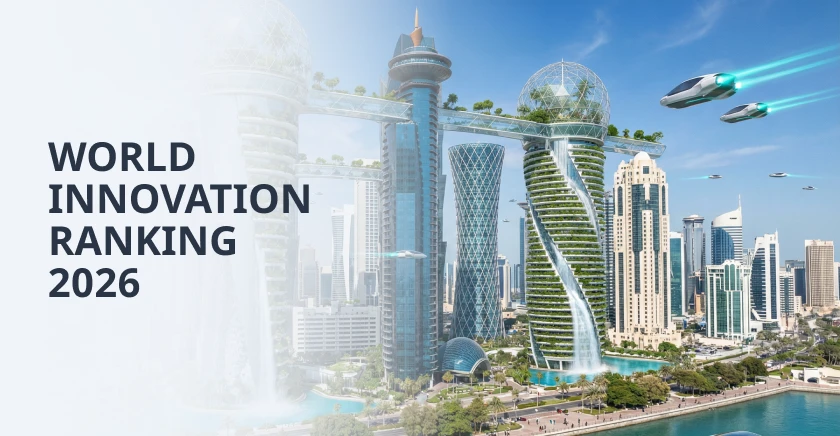
Doha in 2026 is a physical manifestation of its digital ambition. The city has moved beyond the "Smart City" hype of putting WiFi in parks to building Cognitive Cities - urban environments that sense, think, and act. The skyline, punctuated by approximately 57 skyscrapers over 150 metres, creates a dramatic silhouette against the Gulf, but the real innovation is happening in the infrastructure that runs beneath the streets.
Lusail City: The Future Living Lab
Lusail is the crown jewel of Qatar’s urban planning. By 2026, it will be a fully functioning city, not just a construction site. It serves as a living laboratory for the "Agil Smart City OS", a platform that integrates every aspect of city management.
- Automated Waste Collection: The city utilizes a vast pneumatic waste collection system (PWCS). A network of underground pipes transports waste from towers to processing centers at high speeds, eliminating the need for garbage trucks and reducing carbon emissions and noise pollution.
- District Cooling: Lusail’s cooling network is one of the largest in the world, saving 65 million tons of CO2 annually compared to conventional AC. It uses chilled water pumped from central plants to cool entire districts.
- Mobility Integration: The Light Rail Transit (LRT) is integrated with the traffic management system. Sensors detect passenger density and traffic flow, adjusting signal timings in real-time to prioritize public transport.
Msheireb Downtown Doha: Heritage Intelligence
If Lusail is the future, Msheireb is the “future of the past.” It is the world's first sustainable downtown regeneration project, and by 2026, it will be the operational heart of Doha's tech scene.
- The Sensor Mesh: With over 650,000 IoT sensors connected to the "Msheireb Brain," the district monitors energy usage, water leaks, and even waste bin levels in real-time. This data allows for predictive maintenance, reducing operational costs by 30%.
- Climate Engineering: The architecture is designed to capture the prevailing "Shamal" winds, naturally cooling the streets. Combined with retractable roofs and orientation analysis, the microclimate in Msheireb is up to 10 degrees cooler than the surrounding city, encouraging walkability—a radical concept in the Gulf summer.
Sustainability & Climate Tech
Innovation in Doha is existential; it must solve the problem of living in a hot, water-scarce environment.
- Vertical Farming: Startups backed by Al Faisal and QDB are deploying hydroponic vertical farms in industrial areas, reducing the reliance on food imports.
- Solar Integration: The Al Kharsaa Solar Power Plant is being supplemented by decentralized solar integration in Lusail, where building facades are increasingly being equipped with photovoltaic skin.
Barriers & Challenges: The Friction of Growth
Despite the immense capital and vision, Doha’s ascent is not without friction. In 2026, the city faces distinct structural hurdles that act as brakes on its hyper-growth potential.
The Cost of Living Paradox
While Doha is positioned as an alternative to Dubai in terms of value, offering a cost of living that is approximately 23% lower, it remains an expensive city globally. Rent in premium areas like The Pearl and Msheireb is high due to the influx of highly paid expatriates. For early-stage startups that are bootstrapped, the "burn rate" in Doha can be very high. Unlike Riyadh, which has vast suburbs with cheaper housing, the geography of Doha limits real estate prices, keeping them elevated.
The Talent Deficit & "Missing Middle"
The "Mustaqil" visa has successfully attracted top-tier founders and senior executives, but there is a "missing middle" of mid-level engineers, product managers, and growth hackers who often find Dubai's lifestyle or Riyadh's salary premiums more attractive. Recruiting a specialized AI engineer to move to Doha requires heavy incentives and often inflates the wage bill for startups, making it a difficult sales pitch.
Regulatory Fragmentation
While QFC and QSTP offer "common law" environments that are investor-friendly, the interface with the "onshore" state economy can be complex. A startup licensed in the QFC may face bureaucratic hurdles when trying to sign contracts with government ministries that operate under different legal frameworks. The "dual licensing" system is improving but remains a source of friction for B2B companies.
Market Size Limitations
With a population of ~3 million, the domestic market is a sandbox. It is excellent for piloting (as seen with HealthTech), but it is insufficient for scaling. Qatari startups must export almost immediately in order to survive. However, cross-border trade in services within the GCC is still not seamless. Fintech licensed in Qatar do not have automatic "passporting" rights to operate in Saudi Arabia, forcing startups to duplicate legal and compliance costs.
Conclusion: The Innovation Vote
Doha in 2026 presents a compelling case study in strategic focus. It resisted the temptation to copy the "tourism-first" model of Dubai or the "industrial-first" model of Riyadh, instead doubling down on being a boutique high-intelligence hub. The city leverages its sovereign wealth not just to build buildings but also to build capacity in AI, data sovereignty and human capital.
The "Qatar Model" has high barriers to entry, but it also offers high rewards for those who fit its strategic mold. It is not a place for a generic e-commerce drop-shipping startup, but rather a cleantech engineering firm or a specialized fintech company, or even a sports-data AI lab. This city has traded volume for value and, in doing so, secured its position as the "brain of the Gulf".
As we approach the vote for the "Innovation Ranking," data clearly highlights sectors where Doha has gone beyond regional parity to become a global leader.